


Acacia johnsonii Pedley, Austrobaileya 1: 245 (1980)
Gereera Wattle , Geereva Wattle
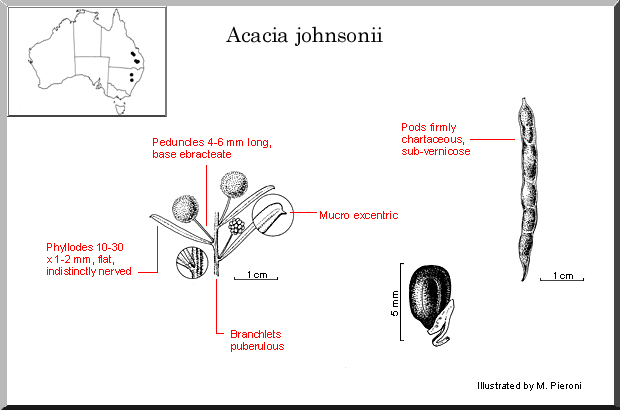
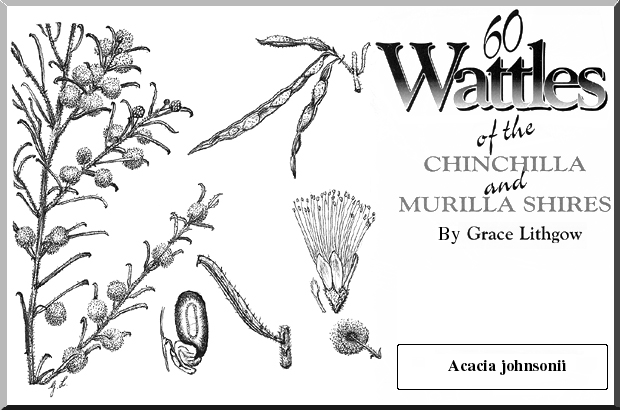
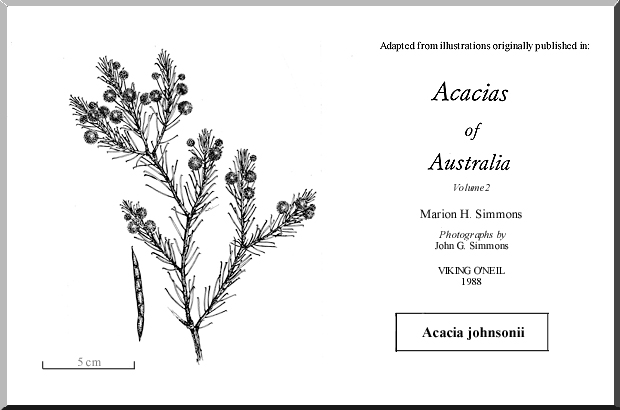
Shrub 1.5–3 m high, branching from base. Branchlets usually puberulous, slightly resinous. Phyllodes patent to erect, linear to narrowly linear, straight to shallowly incurved, flat, 1–3 cm long, 1–2 mm wide, commonly narrowed at base, excentrically and obliquely mucronulate to rostellate, green, glabrous or subglabrous, indistinctly 1–3-nerved; gland minute, basal, sometimes also at base of mucro. Inflorescences simple, single in upper axils; peduncles usually 4–6 mm long, glabrous to puberulous, the base ebracteate; heads globular, 20–30-flowered, golden, slightly resinous. Flowers 5-merous; sepals 2/3–3/4-united, with acute lobes. Pods to 7 cm long, 3–5 mm wide, firmly chartaceous, reddish brown, glabrous, subvernicose. Seeds longitudinal, oblong, 2.5–4 mm long; aril oblique.
Occurring in south-eastern Qld in the Chinchilla area and at Jericho. Occurs also on the North Western Plains of N.S.W. near Enngonia. Common in sand in shrubby open forest near Chinchilla, and, in N.S.W., uncommon on sandplains in spinifex communities.
Phyllodes of A. johnsonii are variable but always rather short, flat and without a broadened lower margin as in A. burbidgeae . Specimens with broad phyllodes and possessing a somewhat pronounced midrib correspond to the type of A. lauta .
Acacia johnsonii together with a number of mainly Qld species constitute the suite of closely related species referred to here informally as the ‘A. johnsonii group’ (i.e. A. barakulensis , A. burbidgeae , A. calantha , A. eremophiloides , A. gnidium , A. hendersonii , A. hockingsii , A. islana , A. ixodes , A. lauta , A. pilligaensis , A. resinicostata and A. rubricola ). These species are all resinous to some degree, they have non-racemose inflorescences with the peduncles lacking a basal bract. This group has affinities to A. brachyclada , A. handonis and A. dictyophleba and its allies. Acacia helmsiana which is currently placed in the ‘ A. wilhelmiana group’ would perhaps be better placed in the ‘A. johnsonii group’
Acacia johnsonii sometimes resembles narrow phyllode forms of A. wilhelmiana .
Type of accepted name
Chinchilla- Auburn road, 28 miles [45 km] N of Chinchilla, Qld, 18 Sept. 1963, R.W.Johnson 2684 ; holo: BRI; iso: BRI, CANB, K, MEL, MO.
Synonymy
Racosperma johnsonii (Pedley) Pedley, Austrobaileya 2: 350 (1987). Type: as for accepted name.
Acacia rigens var. humilis Benth., London J. Bot. 1: 342 (1842). Type: ‘Native of Bowen [Qld], bushes in S.W. interior, flowers in Sept., a dwarf shrub’, C.Fraser ; holo: K, fide R.S.Cowan & B.R.Maslin, Nuytsia 12: 437 (1999).
Illustrations
L.Pedley, Austrobaileya 1: 232, fig. 8K (1978), phyllode only; G.M.Cunningham et al. , Pl. W New South Wales 364 (1981); M.Simmons, Acacias Australia 2: 77 & pl. 20 (1988); T.Tame, Acacias SE Australia 119, fig. 123, pl. 123 (1992).
Representative collections
Qld: Jericho, June 1913, J.L.Boorman (NSW); Waaje Tower Rd, Barakula Forest, 11 Aug. 1986, V.Hando 2 (PERTH); N.S.W.: ‘Nulty Springs’, Enngonia, G.M.Cunningham 481 (NSW).
(BRM)
The Fl Australia treatment of A. johnsonii has been modified here for WATTLE in that A. lauta is treated as a distinct species.

The information presented here originally appeared on the WATTLE CD-ROM which was jointly published by the Australian Biological Resources Study, Canberra, and the Department of Parks and Wildlife, Perth; it was produced by CSIRO Publishing from where it is available for purchase. The WATTLE custodians are thanked for allowing us to post this information here.